Nagasaki day trip

We bummed out to Nagasaki to check out the Peace Park and do a little shopping. There is no fast way to get to Nagasaki by train. Even by limited express – the fastest option available – our transit time was almost two hours.

Perhaps because the train was a little slower, Locutus showed an interest in looking out the window for a substantial part of the journey. And what a view! One side is ocean, the other mountain. Lots and lots of hills, covered in bamboo forests and orange groves.

 Cue travel montage
 Terraces

Upon arrival in Nagasaki we were greeted by a midweek market. It appeared to be a sponsored event of some sort. If we were back home, I’d say one of the local radio stations was hosting an ‘on-location’ type of event day. In addition to the market, there was a stage area set up. Several children groups took turns performing for the shoppers. It was adorable.

Dance Dance Revolution
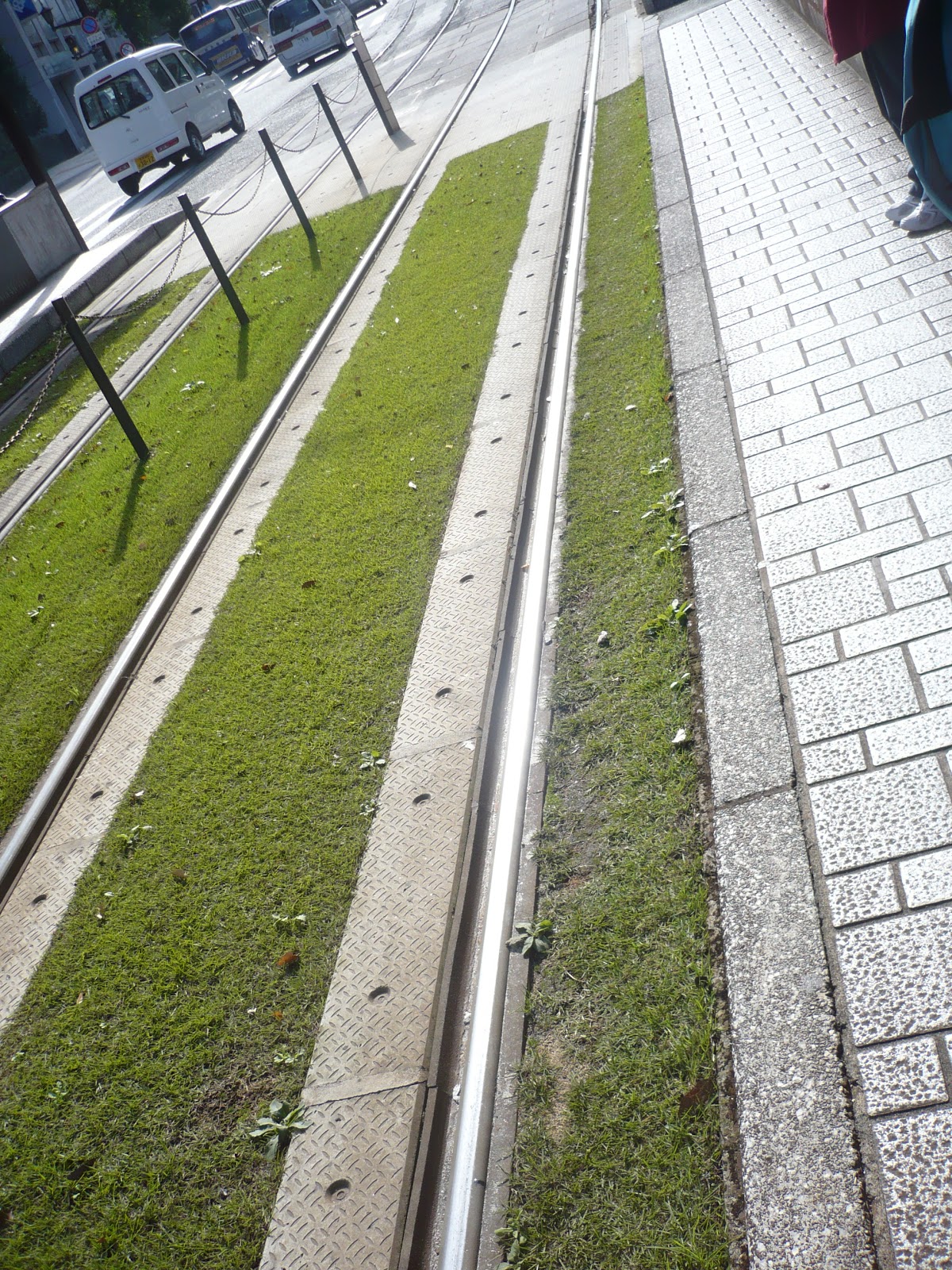
Like Kumamoto, Nagasaki features a tram. But the tram looks like it was laid down shortly after the initial destruction of the city and it hasn’t changed a whit. Hopping on a 1950’s streetcar certainly set the mood for our trip to the Peace Park. We’ve gotten to use the trams a lot.
Tram central

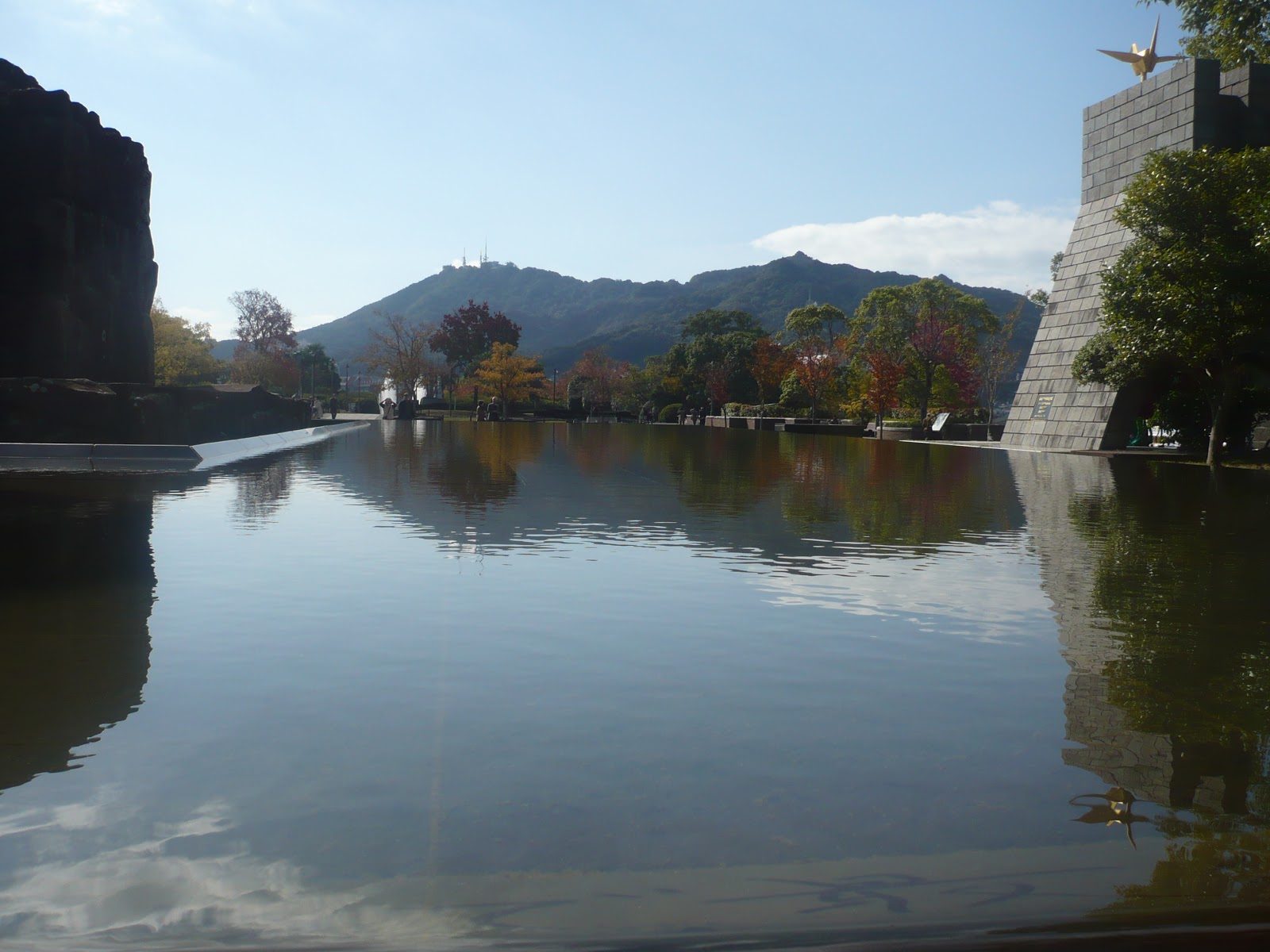
The Peace Park was mostly paved. It featured the rather enormous Statue of Peace. The statue was surrounded by the Pool of Peace. There were billions of Origami Cranes of Wishing (for Peace). And it was a gorgeous, sunny day. We let Locutus cruise the park, working on the Steps of Peace and School Girls for Peace, alternately and concurrently.

Steps to Peace Park in full bloom
 

The Statue of Peace
 
 
The Pool of Peace

Paper Cranes of Wishing (for peace)
 
 
 Foo dogs of Peace, yo
H-Bomb Hypocenter debris


 Autumn in Nagasaki, part 1


Autumn in Nagasaki, part 2
 

A tour guide popped over while we were walking Locutus along the Benches of Peaceful Group Photo Opportunities. We chatted for a while about Nagasaki. He recommended visiting the Glover Park. The flowers were currently in full bloom. Because Kyushu does November correctly.

We left the park after a few hours. We took the tram back to the station, but hopped off a few streets early so Jenn and I could shop for souvenirs while Locutus napped in the carrier. Sadly, while we found a lot of great photo opportunities and thoroughly enjoyed the sunshine and summery day, we were unsuccessful in our shopping endeavors.


 Stone Stairs of Peace
 Drainage ditch of Peace
The Balcony of Peace
 

We arrived back at the station, grabbed some Osaka-style okonomiyaki from the takoyaki stand (Hiroshima style is vastly superior), and then debated visiting Arita.

Sorry Osaka, Hiroshima-style Okonomiyaki (of Peace) is superior!

Imari/Arita is a town in Saga prefecture (between Nagasaki and Fukuoka) famous for its pottery. No fast trains go there, however, and the trip from Nagasaki to Arita is by local train only – a trip a little over 2 hours. Facing the prospect of another 2 hour trip from Arita to Hakata afterwards, and not really wanting to do anything in Arita aside from browse the stores, we decided to throw in the towel and return back to Hakata directly.

 Cue return montage
Sunset journey
 
So far, aside from our success in Kyoto at the beginning of our trip, we haven’t found many great opportunities for souvenirs. It’s been a little frustrating.

Moto ‘moto!

We’re 2/2 for castles involving ‘motos in Japan. We visited Kumamoto castle early in the morning. It is a 36 minute hop, skip and shinkansen away from Hakata.

The city features a tram, which courses through-out the city. It had rails and everything. It was pretty cool. We bought passes for the tram at the station. We planned to use the tram a lot.

 Moats!

While the city of Kumamoto wasn’t quite as quaintly quaint as the quite quaint village of Matsumoto, the castle and fortifications were magnificent. Our plan was to stop at Kumamoto Castle to let Locutus storm the ramparts and then zip over to Suzenji Garden for some natural landscapes. Our plans were waylaid, however, when Kumamoto Castle broke out the dance team. But don’t worry, we’ll get to that.

 This doesn’t look so tough

A brief miss-remembered history! Kumamoto castle was built a long time ago by a military type person in Japan. He was a pretty clever guy and built a pretty clever castle. Or, more specifically, he built huge, nigh-impenetrable stone fortifications and turned the naturally-defensive terrain already existent into multiple murder zones, around a rather typical castle. Which was good! Because the castle burned down before the rebels arrived.

And it was rebuilt! For us! With dance teams! But don’t worry, we’ll get to that.

It’s hard to define the castle grounds. Our tour started in sort of an outer area, which I shall call the outer courtyard for simplicity. It was located between the wall over-looking the moat, and another wall, under-looking more walls. The sky was cloudy but it was very warm, so we set Locutus down and let him relocate gravel while we read the infographics.

 Well
 

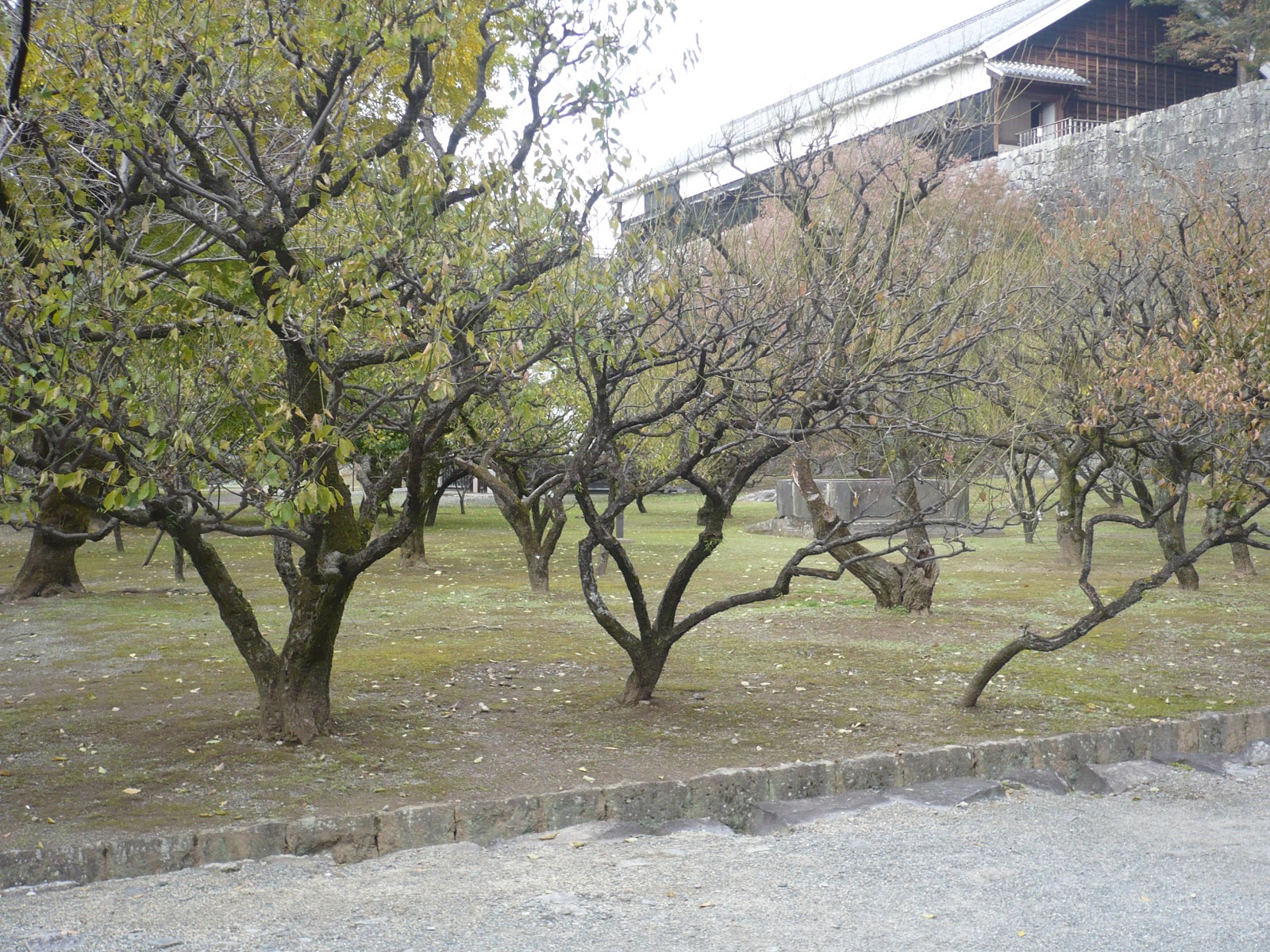
In the outer courtyard was a reconstruction of a covered well, one of some 160 individual wells the clever lord had dug inside the castle fortifications to withstand sieges. This courtyard featured some lovely trees in a variety of hues, a small garden, and a lot of gravel. After some photography, we began our approach to the castle. The stairs looked a bit tricky so we bundled Locutus back into the carrier and set out on our path.

 Stairs


The path took us along side one wall to a set of flagstone stairs. Even here, the inner walls were about 30 feet high, sloping gradually from sheer-precipice to really-sheer-precipice. The stone steps led us up one level to the top of the wall and… from the outer courtyard, you can kind of see the castle, but only the top. The inner wall is rather tall and masks a lot of the visibility. It turns out, it also hides another set of walls. Which, in turn, hide another set of walls and then…a small orchard, neatly placed beneath another set of walls. And all of this is accessible by a nice, open-air stone corridor and more-than-adequate firing lanes.

The orchard
This climb should be on the next Tough Mudder

The final set of castle walls was about 60 to 80 feet tall, featured some wooden fortifications built atop the walls (complete with the usual assortment of murder holes and arrow slits that any well-to-do castle attacker would expect to see), and yet another long set of stairs up to…

Hey, that looks like castle!
Just one more flight of stairs, right?
  

Hah! Fooled you! That’s still outer castle wall you saw before. And the wooden building was just the final outer fortifications (now a gift shop!). Good guys are so dumb.

 That’s no castle!

But congratulations! You made it this far, so you can see the actual castle! It’s another 80 feet directly above you! If you just follow this tunnel through the inner wall here and…more murder holes! I can’t believe you fell for that!

But seriously, if you come up these open stairs you’ll get to the courtyard. And now! There! The castle! And it’s run out of walls. It’s your lucky day!

Kumamoto castle

And it was our lucky day, too! Because shortly after we arrived at the summit of Castle Kill-a-ma-bob, they announced that they were doing a historical samurai show. We thought, cool! That sounds like when our friends would dress up in fur hats and dingy coats and stand around in Fort Langley telling people about how cold it was and how to best depopulate entire species in the process of staying warm.

  Let’s learn history through the art of interpretive dance!

Instead, they put on samurai armour, broke out some kendo and instructed us on historical happenings while beating up bad guys. Then! Then! After finishing the first account of someone dumb enough to think storming the castle was a good idea (yet obviously charming enough to convince other people to come along!) they paused the history lesson and did a dance routine.

It. Was. Awesome.

I mean, they had me at the hackin’ history lesson; the katana-twirling soft-shoe made my eyes misty. The whole demonstration went on for about an hour. But we couldn’t really understand any of it, so after the second history lesson started we let Locutus loose to roam the yard. We let him hold court until he started to get tired.

We wrangled him back into the carrier to explore the castle. I’m not sure when the reconstruction took place because a lot of the inside did not appear to be ferro-concrete reconstruction, which is normal for castles rebuilt in the last century. I have an internet. I could probably look this stuff up. But so do you. And so can you. So stop interrupting my narration.

The museum had some cool stuff: a wooden model of the castle used during the reconstruction process, bits of old things, family history tidbits, and pointy bits of metal. The material was well represented in multiple languages.

The views from atop the castle were spectacular (terrifying) and they even had some of the windows open (more terrifying!) which I was brave enough to lean out of (not even close!) and snap some photos without dropping my camera (totally didn’t drop it!). The castle also featured a photographic list of all the castles in Japan! We’ve been to…maybe six? Only thirty five left to go!

We toured the rest of the grounds some more, stopped by the nearby Edo-era-appropriate shopping arcade for rose-flavored ice creams, and realized we’d had no time for Suzenji. We broke for lunch, then boarded the tram back to the station. We didn’t use the tram a lot.
Shopping area
 Purple ice cream
 
Shhh! We’re hunting twams!
 

PSA: Calpis Sour

Regulars at our sumo nights will be familiar with the unfortunately named Calpis Soda. For those not in the know, Calpis Soda is a beverage of Japanese origin. It is a calcium drink. And no matter how you try to pronounce it, it either ends up sounding like you’re saying cow piss, or that you’re saying cow piss with a French accent. Regardless, it is the drink equivalent to the center of a creamsicle and once you start drinking it, it’s impossible to stop until it’s all gone.

Not content with poorly named perfection, the Japanese decided to take Calpis soda to the next level: they added vodka.

Voila! Calpis Sour. I don’t know why it’s called Calpis Sour. It’s not sour at all. It tastes like the center of a creamsicle with the barest hint of vodka. But just like the original, once you start drinking it, it’s impossible to stop.

Sumo ga sukidesu ka?

On the second or third day of sumo, we headed to our usual general admission seats (very top left corner of the TV screen, in case you’re wondering) only to find a group of very drunk, very rowdy men in our area. We joined them. They were all septuagenarians.

We like our sumo and we’re happy to cheer. They liked their shochu and were happy to share. And best of all, we all loved sumo and liked all the same fighters. Which is to say, they all cheered for whatever fighter I cheered for. It was synergy.

They were well into their drinks when we joined them. One gentleman had taken on the role of Master of the Cups, which involved making sure that his friends cups were never empty. Nor did they have to get up for a refill, because that would be potentially disastrous and/or crippling.

Locutus isn’t able to sit still through the entire day, of course. Jenn and I take it in turns to walk our son around the stadium. Often, strangers will grab our son and run off and sell him on the slave market because we’re in Asia and they do that in…wait, no. They hug him and coo at him. Because he’s adorable. And we’ve gotten very good at answering the same questions: how old he is, where he is from, and his propensity to endure slave shop labour conditions.

Okay, kidding! Kidding! They don’t ask us where he’s from. And it’s only the old ladies that insist on hugging him. But we’ve made friends with a great many regulars in the crowd and they all smile and wave as we pass by. And we make new friends every day.

But this story is about the drunk old men. The drunk old men took a particular shining to us. It may have been our adorable son. It may have been his very pretty mom. Or it may have been his dad cheering crazily for their national sport. Whatever the case, they began giving us gifts.

At first, it was the shared drinks. Then one fellow brought us some oranges and cakes. Another brought a can of pringles, some sumo cookies and fish snacks while Locutus and I walked up and down the stairs. There was congratulatory fish jerky when Ikioi won (GANBARE, IKIOI!). And on the way out one of the fellows insisted on giving Locutus some money for snacks.

Some of the free stuff Locutus has scored so far

I could barely understand anything they said because, hey, they were pretty drunk, and spoke fast, colloquial Japanese. Not my strong point. And they couldn’t understand anything I said because, hey, mediocre Japanese student! But in the end it didn’t matter one bit. We watched sumo together and cheered together and the language barrier wasn’t a barrier at all.

And you can TOTALLY hear us yelling madly during Ikioi’s match.

Nightlife in Hakata

So we took our son to a bar our first night in Fukuoka. We were going to pass by, but the nice waitress stopped us and insisted we come inside. She broke out her best English: Chicken! Beef! Pork! Fish! and pointed at the menu in appropriate places. And we thought: okay! It was long past time that Locutus had a pub crawl.

The pub served Japanese style kebabs and other tapas foods. We settled into our table and Jenn ordered us some dinner while I wrangled Locutus. We haven’t taken Locutus out to many restaurants back home, and none since he was able to walk, so dining out has been a bit of an adventure. We quickly established a perimeter at the table of things Locutus could touch and things we didn’t want to pay for if broken.

We were a bit concerned that Locutus was going to be a bit to raucous for the pub, but we were quickly disabused of the notion. Not that Locutus wasn’t a pest. But rather, he was a rakish, adorable pest that some might call charming, and whose good looks and impish smile quickly charmed every lady in the restaurant. It was quickly apparent that everyone loved our son. So we passed him around the bar.

Hah! That’s how you give multiple grandma’s a heart attack! Just kidding, grandmas!

But seriously, we passed him around the bar. To one side, a mother and her daughter had just come from shopping. Locutus found the young girl rather pretty and so kept trying to steal her shopping bag while she was distracted. To our other side was a couple of ladies a bit older than us, who were actually practicing English lessons. One table beyond them was a mother and her son, who was a bit older than me. Everyone wanted to hold him. Locutus was happy to be held by everyone that was not a man.

Meanwhile, Jenn and I spent the evening chatting up our various neighbours in a mixture of broken English and broken Japanese. The food was pretty okay and the sake was not terrible, but the company was fabulous and we made several friends, if only for the evening.

Fukuoka

Part of our decision to stay in Himeji was to break up the trip from Kyoto into two smaller trips. An unintended consequence was that Himeji is really only a sight-seeing stop-over between Kyoto and elsewhere and we weren’t able to get a seat on a train until much later than we planned. We did not arrive in Fukuoka until later in the afternoon, which was too late to buy general admission tickets. Instead, we watched the first day back at our hotel room, in high definition, with instant replay and commentary.

Statue in front of Hakata Station


Our first few days in Fukuoka mostly revolved around getting settled in the city. We selected a hotel near Hakata station, familiarized ourselves with the walk and transit options to the sumo stadium, and then stocked up on some sundry items like diapers.

The first couple days were cold and blustery in Fukuoka. We spent those days at the sumo stadium, cheering for our wrestlers while Locutus charmed the ladies. Locutus enjoys the sumo but he enjoys being the center of attention even more.

When not at sumo we’ve spent our time visiting the local shrines, or browsing the local shopping arcades. But this isn’t a post about Fukuoka, or the many stories therein. This is a post about Bing Weather.

Bing Weather is a feature in Windows 8. It ties local weather forecasts directly into your Windows Experience. Bing Weather sucks.

On our first full day in Fukuoka, Bing Weather called for cloudy with possible light showers. We were caught in a thunderstorm and torrential rains several blocks from our hotel. We went to sumo and when we came out, hours and hours later, the storm was raging on.

So when Bing guaranteed rain the following day, we decided we’d spend the day indoors watching more sumo. And beams of golden sunshine bathed the stadium interior with a gauzy, gilded light.
Clear with a mild chance of sprinkles turned out to mean blustery windstorm accompanied by brief deluges.

As I wandered Kumamoto Castle in shorts and t-shirt weather (forecast: 80% chance of rain, highs around 14C) I began to suspect that Bing Weather is really, really bad at its job.

Sumo

We interrupt this blog chronology to bring you this important announcement.

We are already in Fukuoka and we’ve booked our hotel for the next two weeks. Our son is still with us, despite numerous attempts to trade him for Japanese children. We are staying at the Hakata Green Hotel Annex, which is located adjacent to the Hakata station. For those not in the know, Hakata station is the main railway hub in Fukuoka. Many years ago two cities, Fukuoka and Hakata, merged: Fukuoka was the samurai district and so the merged city took its name; Hakata was the merchant district and so most things are Hakata in Fukuoka. It’s all about the money.

All of the general admission tickets were sold out for the first day. Raku raku seats were available, but none of our lower ranked wrestlers were fighting on day one and we did not feel like springing for the good seats just yet. We watched the tournament on NHK in the hotel room, in HD, while drinking delicious Mystery Drinks (3% to 8%).

Today, however, we were determined to watch some sumo (or, as we’ve learned to pronounce it: smoh). There is a bus from the station that takes us directly to the stadium in about 12 minutes. We boarded the bus, charmed the passengers with our adorable son, and then bought our general admission tickets. True to form, we didn’t actually sit in the general admission seats until much, much later in the day.

Locutus was awesome. He charmed at least a dozen old ladies, who insisted on holding him. (Don’t worry moms! None of them stole your grandson!) He slept during the sandanme and makushita matches (but then, didn’t we all!) and awoke for the Juryo, in time for Yobadashi Kunio’s singing.

While Locutus was very well behaved, we quickly realized that only one of us could really concentrate on the sumo matches at a time. And so, a competition was borne. We each selected 11 Juryo wrestlers. On a given day, whomevers wrestlers perform best determines who gets to watch the Ozeki and Yokozuna fights, and who gets to wrangle the Borg.

The game is ON!

Nijo Castle

We visited Nijo Castle on our second day in Kyoto, amid choruses of “Kawaii!” Nijo castle is very, very big. The sign outside said to allow an hour – but if you visit the castle with an adorable child and a throng of potential admirers, allow two hours. We had the good fortune to visit the castle while seven or eight school groups visited the castle. Locutus was on form, flashing his winning smile and charming the girls.

Fortunately, Nijo castle has several large gravel areas where our son could run and play. Mostly, he spent the time picking up rocks in one area of the castle and moving them to another area of the castle, whilst posing for pictures when a group of school girls passed by.

Eventually we were able to coax our son onto the rest of the tour. Nijo castle consists of the castle itself, which was really more of a sprawling palace with many rooms, each gorgeously painted to inspire envy in visiting dignitaries. The floors were the infamous ‘nightingale’ floors, designed to chirp when stepped upon and alert the castle staff to intruders.

After touring the castle, we moved onto the gardens and the palace. The palace, sadly, was not open to visitors. But the gardens surrounding the palace were quite lovely. Locutus spent an hour or more playing in the drain channels, attempting to climb the fences, and banging his head on the low hanging beams beneath the elevated decks. Successes all around.

The deep drain channels

Elevated deck that was mostly just above Locutus’ head height
 
We climbed the stairs to a viewing platform that displayed the grounds and the myriad of autumn colours. We joined a flock of kimono clad school girls. We snapped photos of the castle foundations and bamboo garden. We were invited to a tea party but decided delicate china wasn’t the best fit for our son. And afterwards we bought umeshu in the lobby. 

We’ll chalk this adventure up as a success.

Eikando II

On our first visit to Kyoto, we stopped into Eikando temple for a visit. It was undergoing restoration at the time, a project undertaken by the local art college. Since Eikando was located between Ginkakuji and Kiyomizu-dera, we decided to drop by and see how the project went. There was also substantial construction underway during our first visit, which we assumed was related to the restoration, but turned out to be an elevator installation for better accessibility.
 
The updated colours inside the building were splendid!  The project was not entirely finished, causing us to wonder if the temple ran out of money, or if the semester ended and the “Eikando restoration 101” course was not offered the following term. We were asked not to take photos of the interior, and in an unusual display of compliance, we complied.
 
 
 There is probably a proper name for these aside from sand art.
The new elevator 
Some of the updated paint on the outside
 

A shot of Eikando from the topmost building

The garden